Conversational, scheduled, event-driven AI agents. Which family to deploy first in 2026?
Conversational, scheduled, event-driven AI agents. Which family to deploy first in 2026?
According to McKinsey State of AI 2025 (1,491 respondents, 101 countries), 71% of companies use AI but only 1% reach operational maturity. The main cause is not technological. It is a taxonomy failure. Most leaders confuse “AI agent” and “chatbot”, launch a conversational assistant on every topic, and watch six months later as usage falls back to zero. This article maps the three main families of AI agents that can be deployed in a company, their operational decision criteria, and the Arkange recommendation by context.
Why talk about three families of AI agents rather than a “universal chatbot”?
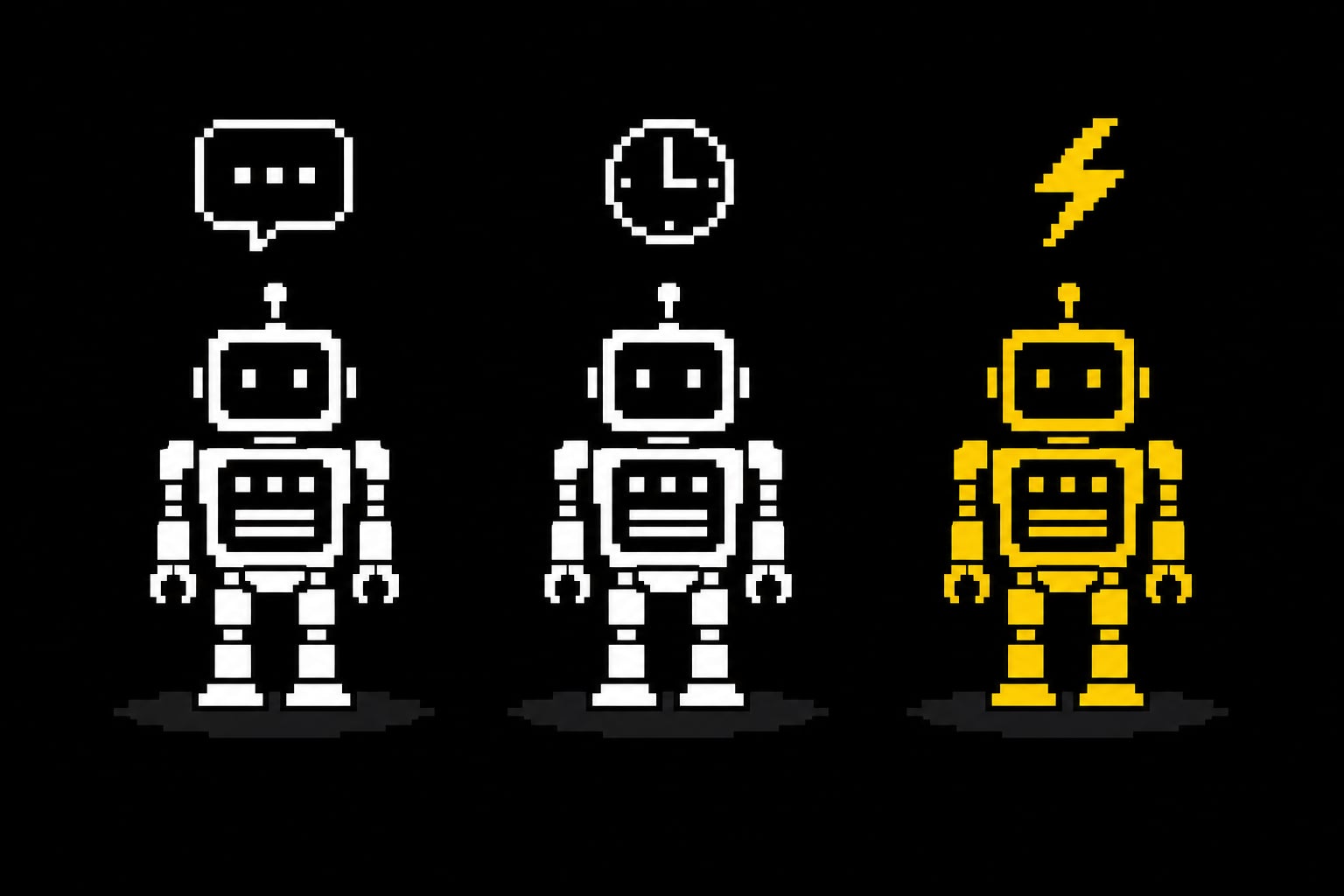
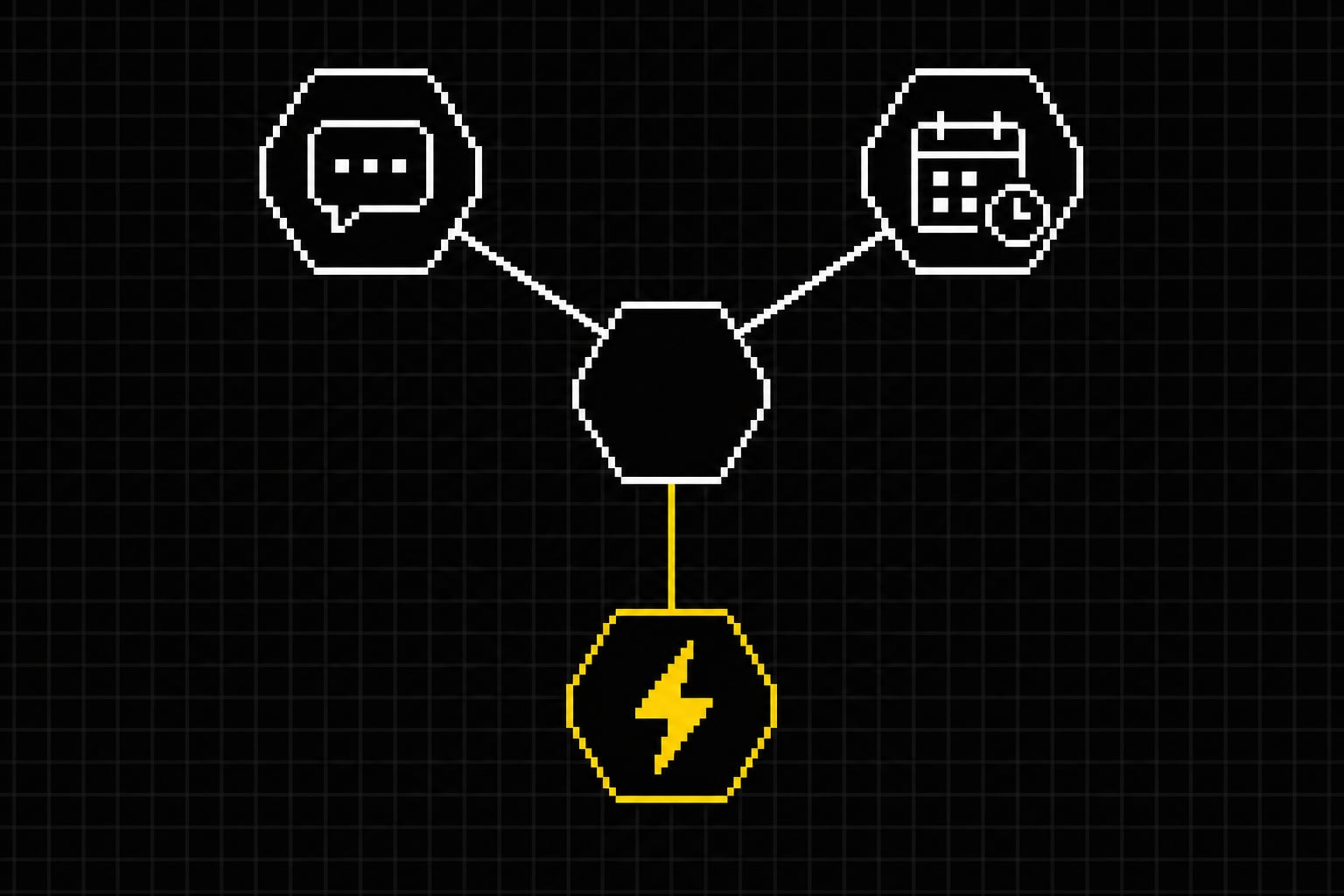
Because an AI agent is defined by its trigger, not by its interface. A conversational agent waits to be talked to. A scheduled agent wakes up on a calendar. An event-driven agent reacts to a business signal (incoming email, uploaded document, new ticket). Confusing these three families means committing to spend on AI nobody uses.
The Stanford Digital Economy Lab study from April 2026 (Brynjolfsson et al., “The Enterprise AI Playbook. Lessons from 51 Successful Deployments”) shows that high-ROI deployments share one thing in common. A clearly identified trigger and a tight business scope. Not a single mention of a “generalist enterprise chatbot” among the 51 cases studied. The myth of the universal copilot is exactly that. A myth.
At Arkange, among deployments observed in 2025, about two thirds of projects started in “a chatbot for everyone” mode are abandoned within 90 days. The projects that survive and scale start with a specific family, on a specific friction. That is the basis of the ADA cycle (Audit, Deployment, Adoption) applied to use case selection.
What is a conversational AI agent and when to choose it?
A conversational AI agent is an agent whose trigger is a human question, formulated in natural language, in a chat interface. It answers, reasons, sometimes executes an action, always in reaction to an intention expressed by a user.
The typical use case of the conversational agent
The conversational agent makes sense when the user knows what to ask but does not know where to look. Typical case. A conversational training assistant that answers trainers’ questions about Qualiopi frameworks, OPCO funding rules and regulatory requirements. The trigger is always a question. The user keeps the initiative.
Other fitting contexts. Internal HR support (questions on the collective agreement, leave, expense reports), document search in a technical knowledge base, and sales assistance in pre-sales on a complex product catalog.
The honest limits of the conversational agent
The conversational agent suffers from a structural problem. If nobody remembers it exists, nobody uses it. McKinsey State of AI 2025 documents an average usage rate of 18% on internal chatbots 6 months after deployment. That is the main trap of the format. A generalist conversational agent reachable from the intranet regularly ends up with a handful of active users three months later. When the same logic is switched to event-driven mode (triggered from the mailbox when a client message arrives with an attachment), adoption takes off on the same target within weeks.
What is a scheduled AI agent and when to use it?
A scheduled AI agent is an agent whose trigger is temporal. Every day at 7 a.m., every Monday morning, every month end. It runs without human intervention, produces a structured deliverable and pushes it to the relevant recipients. No questions, no chat interface.
The typical use case of the scheduled agent
The scheduled agent is unbeatable for repetitive, high-value business rituals. Typical case. A scheduled agent that generates every Monday at 6 a.m. a synthesis of the files due within the week, per employee, with a priority level. The employee opens their screen and finds their day already framed. No question asked to the AI. No prompt to write.
Other fitting contexts. A daily sector press review, a weekly sales report, monthly compliance alerts, and committee summaries prepared the evening before at 10 p.m.
The honest limits of the scheduled agent
A scheduled agent becomes useless as soon as the input data is no longer available at the planned time. Recurring case. A logistics synthesis scheduled at 5 a.m. fails two days out of five because the ERP has not finished its overnight batch. The workaround is to switch to event-driven logic (trigger when the ERP signals end of processing). Lesson. Temporal planning assumes a stable infrastructure. Without it, you industrialize a false positive.
The a16z Enterprise CIO Survey 2025 (100 CIOs surveyed) notes that scheduled agents account for 34% of deployments with documented ROI, the second category after event-driven.
What is an event-driven AI agent and for which processes?
An event-driven AI agent is an agent whose trigger is a business event captured in real time. An email received, a document uploaded, a ticket opened, a status changed in the CRM, an electronic signature validated. The agent reacts, processes and returns the result inside the existing flow. The user does not talk to it, the user receives work already done.
The typical use case of the event-driven agent
The event-driven agent excels on high-volume processes with an identifiable trigger. Typical case. An agent that fires on every document upload in a DMS, classifies the document, extracts the structured data, pre-fills the production tool and notifies the employee when there is an anomaly. The observable order of magnitude for this kind of usage runs around 10 to 15 minutes saved per document, on volumes of several thousand events per month.
Other examples. Automatic qualification of an incoming lead in a CRM, compliance check of a contract as soon as it lands in an e-signature tool, and generation of a standard reply when a support ticket arrives with a recurring reason. On the public sector side, an event-driven agent can process incoming mail requests and propose a draft reply to the case handler before the file is opened.
The honest limits of the event-driven agent
The event-driven agent requires clean integration with the source systems (email, DMS, CRM, ERP). It is the most expensive family to set up initially and the most ROI-positive at 100 days. According to Arkange’s 10/30/100 method, a properly scoped event-driven agent usually delivers its first useful processing in 10 days, reaches stable usage at 30 days and measurable ROI at 100 days. But if the source system’s API is unstable or undocumented, the project derails.
Stanford Digital Economy Lab (April 2026). 27 of the 51 high-ROI deployments studied are event-driven agents. It is the family that produces the most value in a mature company.
Which criterion to use to choose between conversational, scheduled and event-driven?
The main criterion is neither technical nor budgetary. It is the nature of the business trigger. Three questions are enough to decide in 80% of cases.
Criterion 1. Who takes the initiative?
If the user knows they have a need and formulates a question, it is conversational. If the clock takes the initiative at a fixed time, it is scheduled. If a business event (email, document, status) takes the initiative, it is event-driven. This question alone eliminates 50% of false leads.
Criterion 2. What is the frequency of the need?
A sporadic, unpredictable need points to conversational. A regular, calendar-based need points to scheduled. A need triggered by a steady event flow (10+ per day) points to event-driven. Frequency also determines ROI. An event-driven agent on 3,200 monthly events does not carry the same ROI as a conversational agent used 12 times a month.
Criterion 3. What is the organization’s current AI maturity?
On the Arkange AI maturity matrix (5 levels, from N1 Curious to N5 Scaler), N1-N2 organizations are better off starting with a targeted conversational agent (low integration cost, fast learning). N3-N4 organizations should prioritize event-driven agents (demonstrable ROI, possible scaling). N5 organizations orchestrate all three families in parallel inside a coherent agentic architecture.
In a mature industrial organization, the three families can coexist. Conversational for technical document search, scheduled for weekly quality reviews, event-driven for supplier non-conformance processing. But this kind of orchestration assumes an N4-N5 level. Starting there as an N2 is a guarantee of failure.
Which family to deploy first depending on your context?
The Arkange recommendation is direct and not up for negotiation. Start with the family that matches the most painful business trigger in your organization, not the one that looks most impressive in a demo.
If you are an SMB or mid-cap at N1-N2 on the maturity matrix
Start with a conversational agent targeted on a known documentation friction. HR assistance on the collective agreement, search in the technical knowledge base, pre-sales commercial support. Low cost, fast learning curve, strong political signal. Avoid the “chatbot for everyone” trap. Target one business function, one typical question, one defined audience.
If you are at N3 with already 1-2 agents in production
Move to event-driven on your highest-volume repetitive process. That is where ROI becomes indisputable. On quality document management in an industrial environment, this switch regularly produces savings of about 1 FTE per processed scope. The conversational to event-driven shift is the most profitable maturity jump.
If you run business rituals with strong regularity
The scheduled agent is your simplest entry point. Reviews, reports, compliance alerts. On weekly regulatory summaries in a banking or financial environment, a scheduled agent produces its first deliverable in under 10 days according to the 10/30/100 method, because there is no real-time integration to build.
The Arkange thesis on the three families of AI agents
The most expensive mistake in 2026 is not choosing the wrong LLM. It is choosing the wrong agent family. 90% of French companies use AI without a governance framework (Usine Digitale, 2025) and the result is predictable. Chatbots deployed with great noise, abandoned in silence. The conversational / scheduled / event-driven taxonomy is not a theoretical nicety. It is an investment filter.
Arkange’s real differentiator is not knowing how to build all three families. Many can do that. It is refusing to build the wrong one when the client asks for an agent that does not match their business trigger. Saying no to a generalist conversational agent when the real need is event-driven is what separates experimented AI from adopted AI.
AI is not bought, it is operated. And operating starts with naming correctly what you deploy.